
“Romantic love was a clear-cut institution, bolstered by orthodoxy and ritual. When a man lost his wife, it was expected that his world would unravel. But friendship… friendship was a wilderness with no guide. There were no courting rituals one might follow to pursue it, and little sympathy for the gut-wrenching horror of its loss.”
Some books are easy to review. You know exactly what worked, exactly what didn’t, and can immediately put your thoughts into words.
The Great Work wasn’t one of those books for me.
In fact, it’s one of those rare books that I genuinely enjoyed but struggled to pinpoint exactly why. The more I sat with it, the more I realized that the answer wasn’t one particular character, plot point, or theme. It was the overall experience of being immersed in Sheldon Costa’s strange, eerie, and deeply atmospheric world.
As a debut novel, The Great Work is ambitious, unsettling, and unlike much of the speculative fiction I’ve read recently.
What The Great Work Is About
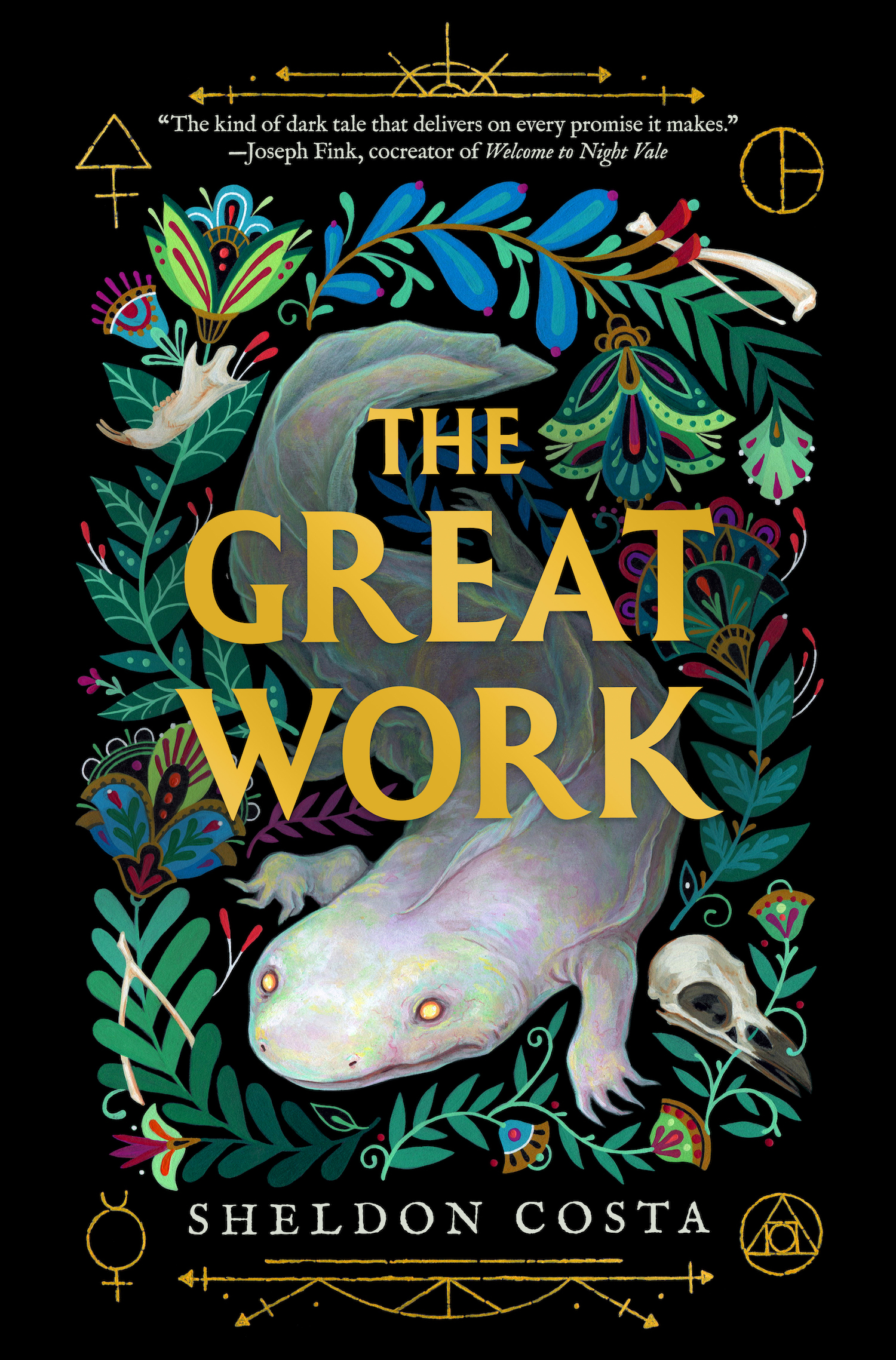
Set in the nineteenth-century Northwest, the story follows Gentle Montgomery, an alchemist grieving the death of his closest friend, Liam.
When Gentle’s nephew Kitt unexpectedly arrives, the two embark on a dangerous journey to find a mythical giant salamander—a creature rumored to drive people mad and create terrifying visions. Gentle believes its blood may hold the key to an alchemical formula capable of bringing Liam back to life.
But they aren’t the only ones searching for the creature.
Hunters, cultists, and others with their own motivations are pursuing the salamander, turning Gentle and Kitt’s quest into something far more dangerous than either of them anticipated.
What I Liked
The atmosphere was easily my favorite part of this novel.
From the beginning, there is a constant sense of unease hanging over the story. The wilderness feels hostile, the visions feel unsettling, and the salamander itself becomes an almost mythical force that influences everyone who comes into contact with it.
Costa creates a world that feels dreamlike and haunted without relying on constant action or horror. Instead, the tension slowly builds through uncertainty, obsession, and the unknown.
The Exploration of Belief
One of the most interesting aspects of The Great Work is how it examines belief and interpretation.
Throughout the novel, different characters encounter the same events, the same creature, and the same mysteries, yet come away with entirely different understandings of what they mean.
Some see opportunity. Some see salvation. Some see danger.
The story repeatedly asks how our beliefs shape the way we understand the world around us, and I found that theme woven naturally into both the plot and character relationships.
Gentle and Kitt’s Relationship
While the giant salamander and alchemy drive the plot forward, the emotional core of the novel lies in the relationship between Gentle and Kitt.
Their journey together adds warmth and humanity to a story that otherwise could have become overwhelmingly bleak. The family dynamics felt authentic and grounded the more fantastical elements of the narrative.
The Weirdness
This book embraces its strangeness.
The metaphysical horror elements, the surreal visions, the alchemical lore, and the mythical creature all combine to create a story that feels distinct from typical fantasy or horror novels.
If you’re someone who enjoys fiction that leaves room for interpretation and doesn’t hand you all the answers, there’s a lot here to appreciate.
Themes Explored in The Great Work
- Grief and loss
- Obsession
- Family relationships
- Belief and perception
- Identity
- Love and acceptance
- Human connection
- Faith versus knowledge
- The consequences of pursuing the impossible
Is The Great Work Scary?
I wouldn’t classify it as a traditional horror novel.
Instead, it leans more toward atmospheric and metaphysical horror. The unsettling feelings come from the visions, uncertainty, and psychological effects surrounding the salamander rather than from graphic scares or constant violence.
Readers who enjoy eerie, thought-provoking stories will likely connect with it more than readers looking for straightforward horror.
Read This If You Enjoy
- Speculative Westerns
- Literary fantasy
- Metaphysical horror
- Mythical creatures
- Quest narratives
- Weird fiction
- Character-driven stories
- Stories centered on grief and healing
- Atmospheric speculative fiction
Tropes and Elements
- Quest to find a mythical creature
- Reluctant travel companions
- Found and fractured family
- Grief-driven journey
- Dangerous wilderness
- Cults and fanatics
- Alchemy and forbidden knowledge
- Visions and nightmares
- Supernatural mystery
- Frontier setting
Final Thoughts
Even after finishing The Great Work, I still find myself returning to the same thought: I liked this book, but I can’t fully explain why.
Sometimes a story works because of its characters. Sometimes because of its plot.
For me, The Great Work succeeded because of the feeling it created.
The atmosphere, the strange mythology, the themes of belief and grief, and the emotional connection between its characters combined into a reading experience that lingered long after I turned the final page.
It isn’t a perfect book, but it’s a memorable one.
And for a debut novel, that’s an impressive accomplishment.